Our Journey
IT STARTED WITH A TASTE I COULDN’T FORGET.
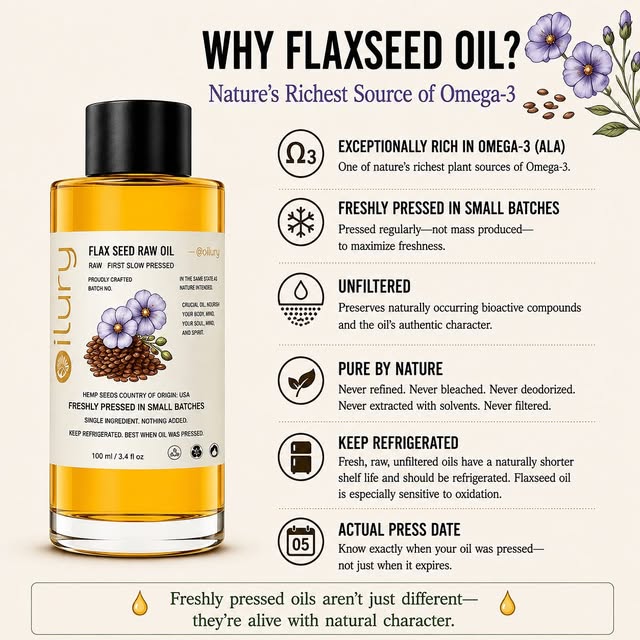
The story of OILURY began during one of my travels through Europe, when I tasted freshly pressed flaxseed oil for the first time.
Svetlana Leontieff, Founder

Chapter 01 — The taste
I thought I knew what flaxseed oil tasted like. But this was completely different — smooth, delicate, remarkably fresh, without the bitterness I had come to expect.
I remember thinking:
HOW CAN THE SAME OIL TASTE SO DIFFERENT?
The answer was simple.

Chapter 02 — Back in California
When I returned to California, I started looking for that same experience.
And I couldn’t find it.
There were plenty of oils labeled premium, pure and cold-pressed — but I couldn’t find oils that told me when they had actually been pressed. I had no way of knowing how long they had been stored, what had happened to them before bottling, or how fresh they really were.
That was when I realized there was something fundamentally missing from the market:
TRULY FRESH OIL.

VISITING a California pistachio orchard
I began researching everything that happens between the seed and the bottle:
How oils are pressed
What they come into contact with
How they are processed and stored
How freshness is protected after pressing
I saw an opportunity to create the kind of oil I had been looking for but couldn’t find.
AND IN 2019, OILURY WAS BORN.
From the archive — 2019
The first bottles.

Three test bottles
February 20, 2019

California walnut raw oil
Pressed June 13, 2019

Pistachio oil and pistachio flour
2019

Pistachio oil
Pressed August 10, 2019

Early hemp oil batches
2019

The first wax seal
2019

An early pine nut bottle
2019

The first farmers market
2019
Chapter 03 — The perfect press
I THOUGHT I HAD FOUND THE PERFECT PRESS.
I researched pressing methods and equipment extensively, determined to find what I believed was the purest and most thoughtful way to produce botanical oils.
At the time, a traditional oak press seemed like the very best choice.
Natural wood.
Natural linen pressing bags.
No conventional metal machinery touching the oil.
After all my research, I genuinely believed I had found the best.
But actually working with the press taught me what research couldn’t.

Press cake in a natural linen pressing bag
Chapter 04 — What the oak press taught me
THE OAK PRESS TAUGHT ME WHAT I NEEDED TO CHANGE.
Under repeated pressure, the natural linen bags tore again and again. The recommended solution was to replace them with heavier synthetic bags.
There was another proposed upgrade: replacing the traditional wooden barrel with a Caprolon barrel.
Caprolon may offer practical advantages, but it is still a synthetic polymer material.
That made me question the entire idea of choosing a press simply because it was “wooden” or “metal-free.”
Natural linen pressing bags
Heavier synthetic bags
Traditional wooden barrel
Caprolon barrel — a synthetic polymer
If natural linen had to become synthetic fabric and wood had to become engineered polymer, I needed to ask a different question:
NOT “METAL OR NO METAL?”
BUT “WHAT MATERIAL SHOULD TOUCH THE OIL?”
That question ultimately led me to 316L stainless steel — a premium, highly corrosion-resistant and non-reactive material, the same premium material trusted in demanding medical applications.
Chapter 05 — Building the press
IF THE PRESS I WANTED DIDN’T EXIST, WE WOULD BUILD IT.
Fortunately, my husband is a structural engineer.
Together, we developed OILURY’s custom-built 316L stainless-steel press, designed around the way we believe exceptional botanical oil should be produced:
01
Slow, gentle pressure.
02
No friction.
03
Temperature controlled below 30°C (86°F).
04
Premium 316L stainless steel.
From oak to 316L
The oak press wasn’t a mistake.
IT WAS MY TEACHER.
The equipment evolved because my understanding evolved.
But the idea behind OILURY never changed. It goes all the way back to that first unforgettable taste of freshly pressed flaxseed oil in Europe.

FRESHNESS CHANGES EVERYTHING.
OILURY — THE GOLD STANDARD IN BOTANICAL OILS.